
How to make feminised cannabis seeds? A complete guide.
How to make feminised cannabis seeds? Making feminised cannabis seeds can be a great way to improve your growing skills. It is not an easy job but a lengthy process in which many things can go wrong. We certainly do not recommend that beginning growers experiment with this, because if you are going to work with pollen in your grow room, you need to know what you are doing. You don’t want to contaminate your grow room with the wrong pollen and end up with unwanted seeds in your weed tops for years to come. Only if you want to continue growing seeds and don’t want to let any more plants flower for the buds in this space can you afford to make a mistake and/or allow yourself to be contaminated with pollen. Feminised cannabis seeds ensure that you almost always get female plants, which means you don’t waste time and space on male plants.
In this guide you will learn everything about the process of making feminised cannabis seeds, including the most commonly used methods and useful tips.
Don’t forget that our master growers have over 30 years of experience growing cannabis and making seeds and have been conducting their first experiments with female seeds since the late 90s. In this blog we’ll give you a peek behind the scenes, but of course we’ll keep the secret STS recipe that makes our seeds so special a secret.
The history of making feminised cannabis seeds
100% female cannabis seeds were the holy grail for cannabis growers for a long time. As early as the 1970s, the American cannabis pioneer Mel Frank tried to achieve this, but eventually had to admit that he had not succeeded in creating 100% female cannabis seeds.
International Growshop/Wholesale De Plantage
The first time that Dutchfem’s later seed breeders heard of female cannabis seeds was in the 90s from Spees Kees Hendriks from The Hague. This well-known Dutch cannabis pioneer regularly visited us in the legendary international grow shop/wholesale De Plantage in Eindhoven and later in Valkenswaard. Space Kees is a legendary figure in the Dutch cannabis world, especially well-known in the underground scene. His name regularly crops up in stories about early experiments with cannabis breeding and innovative cultivation techniques. It had been discovered more or less by accident that seeds that had (again, accidentally) been created by a stressed female plant that had produced male flowers were mainly female. How wonderful it would be if you could develop that further and reliably produce female pollen. He could talk about it endlessly with great passion and he was certain that female seed was the future for all cannabis growers. At that time, the vast majority of Dutch growers still grew exclusively from cuttings instead of seeds. There was still a great deal of mistrust of the first feminised seeds because one male or hermaphrodite plant could ruin an entire harvest and contaminate your grow space with pollen for years. It took at least another 10 to 15 years before feminised cannabis seeds gained a more reliable image. This was partly thanks to another pioneer in the Dutch cannabis scene, Henk van Dalen, who developed better methods that resulted in fewer male plants and/or hermaphrodites from the ‘female’ seeds.
Now, after 30 years of experimenting, selecting, developing and fine-tuning, we can say that we are using a 100% reliable method that produces 100% female seeds.
The fact remains that certain circumstances may cause a female cannabis plant to produce one or more male flowers, but this is usually due to external circumstances and not the genetics used. We have also written a blog about this: The 5 most common causes of cannabis hermaphroditism

Why produce feminised cannabis seeds?
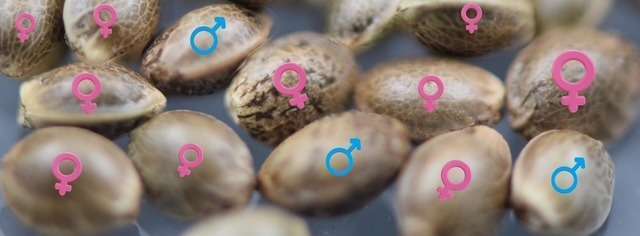
If you use regular cannabis seeds, there is about a 50% chance that you will get a male plant. This is not ideal if you only want to grow flowers, because male plants do not produce buds and can pollinate your female plants. Feminised seeds ensure that you get almost only female plants, maximising your yield and efficiency.
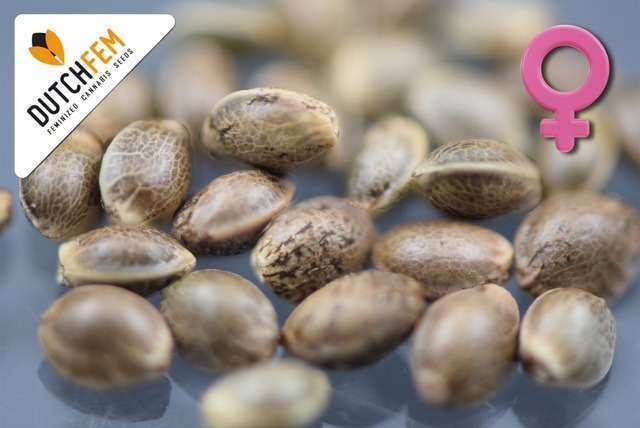
Feminised cannabis seeds are made by forcing a female plant to produce pollen. This pollen does not contain any male chromosomes, which means that all seeds pollinated by it will also be female.
Selecting good genetics for feminised seeds
To make high-quality feminised cannabis seeds, you need to start with the right genetics. This means that you first need to select strong, stable female plants from regular seeds. Here are the most important steps to choosing the best plants:
1. Choose reliable seed sources
Not all seeds are the same. Choose regular seeds from reputable seed banks that are known for their stability and consistent genetics. This reduces the chance of undesirable characteristics such as hermaphroditism.
2. Pay attention to vigour and vitality
During the growth phase, you only want to keep the strongest and most robust plants. Look for characteristics such as:
- Fast and healthy growth without signs of weakness
- Strong stems and branches
- Little to no susceptibility to diseases and pests
3. Test stability over several generations
Good genetics come from stable lines. This means you should select mother plants that show consistent characteristics over generations, such as:
- Equal growth patterns
- Predictable flowering characteristics
- Uniform flower formation
4. Avoid hermaphroditism
One of the greatest risks with feminised seeds is hermaphroditism. Therefore, only select plants that show no signs of hermaphroditism, even under stressful conditions.
5. Test the cannabinoid and terpene profile
Use a test kit or laboratory analysis to check whether the plant has the desired cannabinoid and terpene profile. This helps in selecting genetics that are not only stable, but also offer the desired effects and aromas.
Methods for creating feminised cannabis seeds
There are three commonly used methods to force female plants to produce pollen:
- Silver thiosulphate (STS) method – The most reliable and professional method.
- Colloidal silver method – A slightly simpler technique that works well.
- Rodelisation – A natural method that is less reliable.
We will discuss these methods step by step.
How to make feminised cannabis seeds? 1. Silver thiosulphate (STS) method
The silver thiosulphate method (STS) is a chemical technique in which a female plant is treated with a solution that forces it to develop pollen sacs. This is the method often used by commercial seed banks because it is very effective.
Requirements:
- Silver thiosulphate solution
- Distilled water
- Atomiser
- One healthy female cannabis plant
- Gloves and a mask (for safety)
Step-by-step plan:
- Prepare the STS solution in distilled water.
- Spray the plant with the solution as soon as it enters the flowering phase.
- Repeat the treatment every few days for 2-3 weeks until you see male flowers.
- Collect the pollen as soon as the flowers burst open.
- Pollinate a female plant with the collected pollen.
- Wait 4-6 weeks until the seeds are ripe.
- Harvest and dry the seeds for future use.
Advantages:
- Very high reliability (almost 100% female seeds)
- Often used by professional breeders
Disadvantages:
- Requires chemicals and protective measures
- More complex than other methods
How to make feminised cannabis seeds? 2. Colloidal Silver Method
In this method, you use a colloidal silver solution (a solution with microscopic silver particles in water) to force the female plant to produce pollen.
Requirements:
- Colloidal silver (at least 30 ppm)
- Sprayer
- A healthy female cannabis plant
Step-by-step plan:
- Spray the buds of the plant daily with colloidal silver as soon as it enters the flowering phase.
- Continue spraying until the plant develops male flowers (this usually takes 2-3 weeks).
- Allow the flowers to ripen and collect the pollen.
- Pollinate a female plant with the pollen.
- Wait until the seeds are ripe and harvest them.
Advantages:
- Easier than the STS method
- No need for chemical substances that you have to mix yourself
Disadvantages:
- Requires daily spraying
- The treated plant cannot be consumed (due to the silver particles)
- Less reliable (90 to 95% female seeds)
Making feminised cannabis seeds? 3. Rodelisation (Natural Method)
Rodelisation stresses out a female plant, causing it to start producing pollen itself. This usually happens when a plant remains in the flowering phase too long without being harvested.
Step-by-step plan:
- Let a female plant flower longer than usual.
- Some plants will develop pollen sacs on their own.
- Use this pollen to pollinate other female plants.
- Wait until the seeds are ripe and harvest them.
Advantages:
- No chemicals or special equipment needed.
Disadvantages:
- Less reliable (not all plants react this way).
- Higher chance of hermaphrodite plants.

What should you pay attention to?
- Choose healthy plants: Only strong, healthy female plants should be used for feminised seeds.
- Use only stable genetics: Plants that already tend towards hermaphroditism are not a good choice, because their offspring can inherit this trait.
- Harvest seeds at the right time: The seeds are ripe when they have a dark colour and a hard exterior.
- Store seeds properly: keeping them in a dry, cool and airtight place will extend their lifespan.
Making feminised cannabis seeds Conclusion
Making your own feminised cannabis seeds is a great way to gain control over your grow. The STS method is the most reliable and is recommended for serious growers. The colloidal silver method is a good alternative for home use. Radiation can work, but is not always reliable.
With the right method and care, you can grow your own supply of feminised seeds and enjoy successful harvests for years to come!
How to create a stabilized cannabis strain?


















You must be logged in to post a comment.